

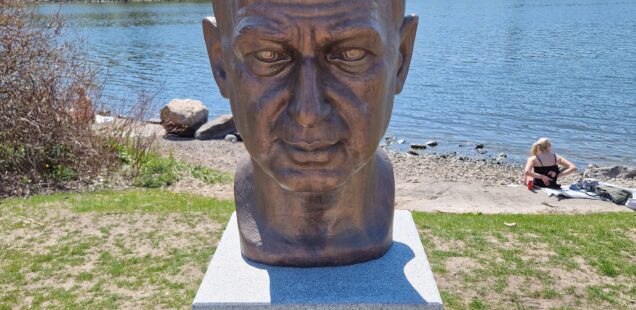
’Markings’ – Learning about the life and writings of Dag Hammarskjöld
Preamble
The notes that are recorded here are intended to convey glimpses and a flavour of the learning during a short course of study of the public life and initially private writings of mid-20th century Swedish economist and diplomat, Dag Hammarskjöld (b. 29th July 1905; d.18th Sep 1961).
The course tutor, Tobias Persson, convened four sessions of a ‘learning circle’ during January and February 2026. The group of learners was trans-national, including people residing in Belgium, England, Italy, Northern Ireland and Ukraine as well as Sweden. By necessity – due to ignorance of Swedish by about half of those participating – the proceedings were conducted in English.
The notes have been compiled by one of the learners, Denis Stewart, in consultation with the course tutor. Like most of his fellow students, he embarked on the learning journey with very little prior knowledge of Dag Hammarskjöld and unfamiliarity with Markings.
For ease of reference, ‘Dag Hammarskjöld’ is often abbreviated to ‘DH’ in the text.
Learning a life
Aspects of Dag Hammarskjöld’s life-story:
- b. 29th July 1905, Jönköping, Sweden; d. 18th September 1961, Ndola, Rhodesia
- Mother – Agnes Hammarskjöld (née Almquist); father – Hjalmar Hammarskjöld
- He spent most of his early life in Uppsala, where he went to school at Kathedralskolan and then studied Philosophy and Law at Uppsala University
- In the early 1930s, he earned a doctorate in economics at Stockholm University
- According to his own account, DH was descended, on his father’s side, from “soldiers and government officials”; and, on his mother’s side, from “scholars and clergymen”
- DH seems to have had an advantageous start in life, having been born and raised in a well-to-do family.
DH’s father served as Prime Minister of Sweden from 1914 and 1917. His period in office was “marked by economic hardship, domestic unrest, and growing tensions over suffrage and food shortages” during WW1. DH’s early career was as a civil servant and included periods:
- as State Secretary in the Ministry of Finance (1936–1945) – working for Finance Minister, Ernst Wigforrs;
- and as Cabinet Secretary for the Ministry of Foreign Affairs (1949–1951) – working for the Foreign Affairs Minister, Östen Undén.
His extra-professional activities included membership of the Swedish Tourist Association and of the Swedish Academy, having been elected in 1954 to take his father’s vacated seat.
In 1953, at the ‘tender age’ of 47 years old DH was elected as the second Secretary-General of the United Nations, a post he held until his untimely death in a plane crash in September 1961. During his tenure as UN Secretary-General, Hammarskjöld gained a widely celebrated reputation as a capable diplomat and administrator. And his efforts to resolve various global crises led to him being awarded the Nobel Peace Prize posthumously.
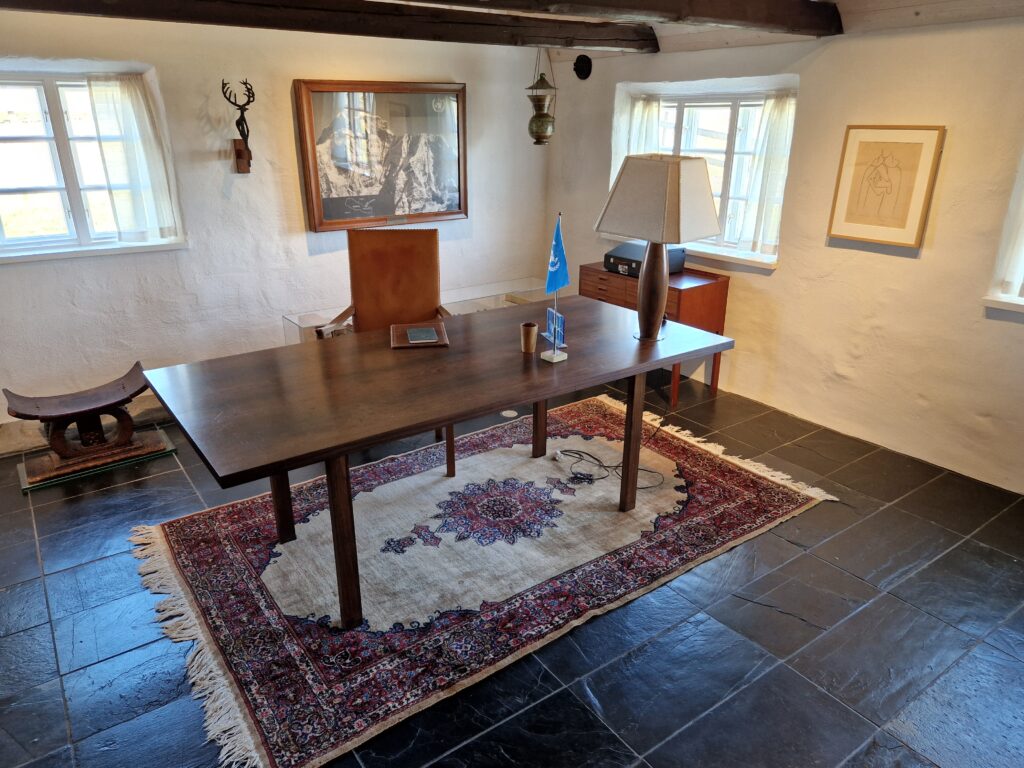
One especially interesting aspect of DH’s legacy is the Meditation Room in the United Nations Headquarters in New York. Sometimes called A Room of Quiet, it was opened in 1952 and then renovated in 1957. Dag Hammarskjöld had a very influential role in the re-design of this “room of utter simplicity”, and in commending its use as a space “devoted to peace ..a room of quiet where only thoughts should speak”.

Remarking on Markings
Having been bemused by the title of Dag Hammarskjöld’s manuscript, as published in a first English translation in 1964, it was helpful to learn that the original Swedish publication was entitled Vägmärken. A literal translation of the title as Waymarks seems much more sensible than the W H Auden’s choice of ‘Markings’. Granted the word ‘waymarks’ has not had much currency in English language writings. But, as Bernhard Erling says in the Introduction to A Reader’s Guide to Dag Hammarskjöld’s Waymarks (1987), having ‘way’ in the title is entirely appropriate because DH has much more to say about ‘the way’ than about the marks or markings he makes along the way.
A selection of quotes from DH’s ’waymarks’ is attached here. The quotes are grouped under themes that were noted during our free-flowing conversation in the learning circle. The quotes are all from the Auden-Sjöberg translation, with page numbers according to the 2006 Vintage Spiritual Classics edition.
In listing these selected quotes from Markings, I have, with one or two exceptions, not attempted to make connections with various writings, not least from those of mystics like Meister Eckhart or Julian of Norwich, from which DH drew (mostly without acknowledgement). For me – at this stage at least – the perspectives and feelings expressed by his chosen words are of much more interest than where those words may have originated. Also, I haven’t taken time to compare the Auden-Sjöberg rendering of the Swedish into English with that provided by Bernhard Erling.

Delving into an untimely death
In the final gathering of the learning circle, we focused on people, places and political circumstances that comprised the context in which Dag Hammarskjöld met an untimely end.
On 18 September 1961, Hammarskjöld was set off to travel to the province of Katanga from Leopoldville in the newly independent republic of Congo. His intention was to meet with Katangese President, Moise Tshombe, in an effort to bring about a cessation of hostilities between Katangese troops and troops in a UN Peacekeeping force that had been deployed to help restore order in Congo. But his aeroplane crashed near Ndola in Northern Rhodesia (now Zambia. Hammarskjöld, along 15 other passengers and the flight crew, perished in the crash.
The circumstances and causes of the tragedy have been and remain unclear and indeed suspicious. The impression conveyed by the outcomes of various investigations and discoveries over the decades since the crash is that it’s highly likely that the destruction of the plane was deliberate. By whom, no one seems to know for sure. And, as to the motivation for such a murderous act, there are various possibilities to ponder. In the learning circle, our speculations included the possible significance of factors such as the business interests of a Belgian mining company, located in the breakaway mineral-rich region of Katanga, and increasingly critical views of several countries, e.g. the USA, UK, USSR, about the proactive UN Secretary-General. Was it the case that Dag Hammarskjöld was “becoming troublesome” and it was thought by some in power that it was time “to put and end to his harmful intrusion”?
Be all of that as it may, the death of Dag Hammarskjöld brought to an abrupt end the life of a very talented human being – a 20th century Renaissance man, who, by all indications, was a person of courage and integrity and, in his role as UN Secretary-General, devoted himself to the pursuit and promotion of peace.
Reflecting on the learning
To finish these notes, just a few reflections on what has been learned about Dag Hammarskjöld – from accounts of his early years and his public life; and from his ‘waymarks’.
Most strikingly, DH comes across as a person who lived in his inner self, ’mindfully’ and meditatively, more than most people seem to do. He believed, as the text that he was heavily involve in drafting for the UN ‘Room of Quiet’ testifies, that we all have within us a centre of stillness, an ‘inwardness’ that is nurtured by contemplative outer silence and in what he called the community of the spirit. For him, religion was not about reality that can be comprehended rationally; rather it was about having an experiential sense of the transcendent yet immanent Divine. Which is what he seems to have in mind when he writes about the fleeting light in the depth of our being, and the steady radiance ..of a wonder, the source of which is beyond all reason. And also when he refers, rather enigmatically, to a transcendental co-inherence [p.70] and finding a restful harmony ..in the eternal moment of co-inherence [p.38].
Alongside and in intimate interaction with this deeply personal and private ‘inner work’, there was in this man’s life, passionate and very public ‘outer work’. For DH, ‘the Way’ was both a quiet, inner exploration and a vocal, outer expedition. In his way of seeing things, the Way ..seeks us and confronts us with demands for action in the outer world. His was an inner freedom in the midst of action, a stillness in the midst of other human beings. So, although he appears to have been rather distant in his social interactions, in his energetic engagement with a world of movement and change, DH seems to have been very attentive to people. One story recounted about his first day/s as UN Secretary-General speaks volumes about the man. He began the new job by walking around the UN building, meeting and talking with the staff.
The picture of Dag Hammarskjöld, about to face into a mountain of risks and challenges in his new role with the UN, going walkabout among his fellow workers connects nicely with his life-long enthusiasm for hiking in mountains – and with the poem that sits on the first page of Waymarks:
I am being driven farther
Into an unknown land.
The ground becomes harder,
The air more sharply cold.
Moved by the wind
From my unknown goal
The strings quiver In expectation.Still questioning,
Shall I arrive,
Where life rings out
One clear simple note
In the silence.
Themes in these poetic lines – of moral clarity and possibility, harmonious simplicity and silence – are colourful threads running through the life tapestry of this remarkable human being.

List of resources
Who killed Hammarskjold – Susan Williams
A Character Sketch – Brian Urquhart
The Way Chose You – KG Hammar
The Hammarskjöld Society – Caroline Hammarskjöld
Decoding the Unicorn – Sara Causey
Denis Stewart